

From cancelled flights in Atlanta to suspended routes across the Eastern Mediterranean, the US-Iran war has turned 2026 into aviation's hardest year since COVID. Here is what is happening, what it costs, and how to travel smarter through it. If you have been watching the travel and hospitality news lately, you already know that 2026 is unlike any year the industry has faced in recent memory. The US-Israel war on Iran, which began with strikes on February 28, triggered a cascade of flight cancellations that has now spread far beyond the Middle East. Airlines canceling flights to Israel was just the start. By the first week of March, the Iran conflict disruption had touched routes across Europe, the Eastern Mediterranean, South and Southeast Asia, and even US domestic travel, where Hartsfield-Jackson Atlanta International Airport logged over 200 cancellations on individual days.

War, Cancelled Flights, and the Future of Travel: What the Iran Conflict Means for You
War, Cancelled Flights, and the Future of Travel: What the Iran Conflict Means for You
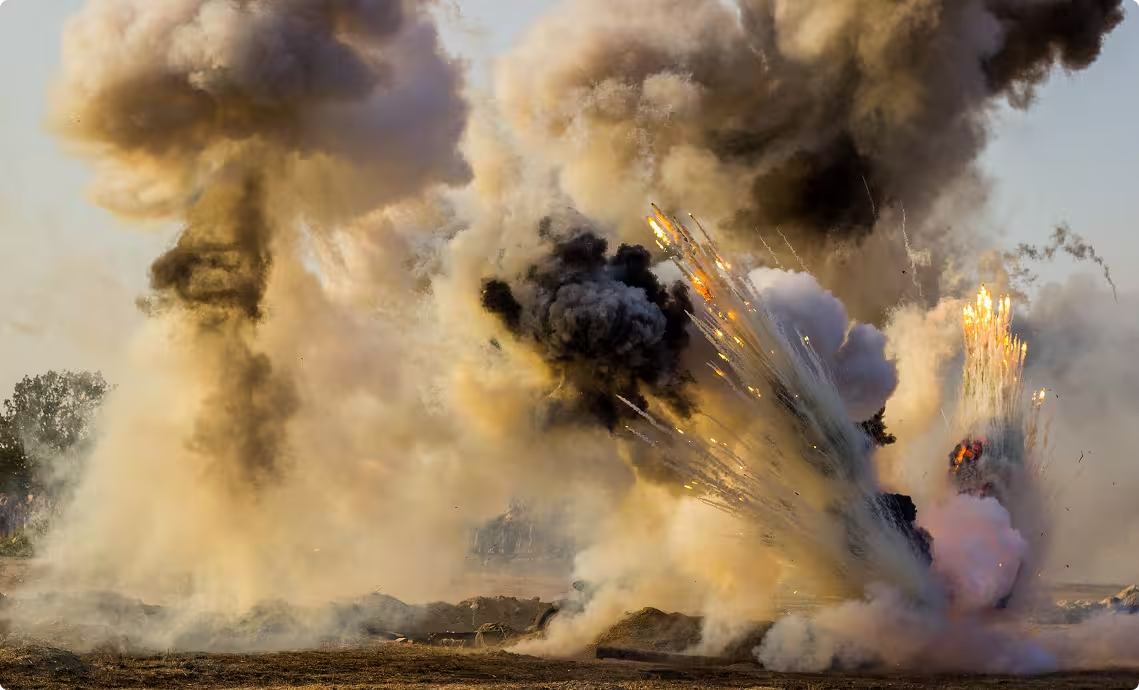
Are we at war with Iran? Formally, yes. The US-Israel strikes on Iran on February 28 started a conflict that, as of late March, shows no clear signs of a ceasefire. The Iran-Israel war has joined a growing list of crises that have made traveling in the US and internationally harder, more expensive, and more uncertain than at any point since 2020.
Passport Validity: Before applying for a Schengen visa or ETIAS, you must ensure that your passport has three months' validity beyond the departure date. An expiring passport will not be eligible for the visa.
The Iran-Israel War and What It Actually Did to Aviation
Open Flightradar24 over the Gulf right now and the effect is unmistakable. Where one of the world's most congested aviation crossroads should appear, a dense web of connections linking Europe, Asia, and Africa, there is a gap. A hole in the sky. Airspace over Iran, Iraq, Syria, and Jordan is closed. The Eastern Mediterranean region carries FAA warnings. Kuwait International Airport has been damaged by drone strikes and is on hold for commercial operations. Dubai International, the world's busiest airport for international passengers, was evacuated after retaliatory Iranian strikes caused damage nearby. Emirates, Qatar Airways, and Etihad together handle roughly a third of all passenger traffic between Europe and Asia, and more than half of all flights from Europe to Australia and New Zealand. When the American and Iran war knocked out Gulf operations, there was no clean workaround for those networks. "This has spiraled into an aviation quagmire." - Henry Harteveldt, Atmosphere Research Group
Which Airlines Are Canceling Flights, and Where
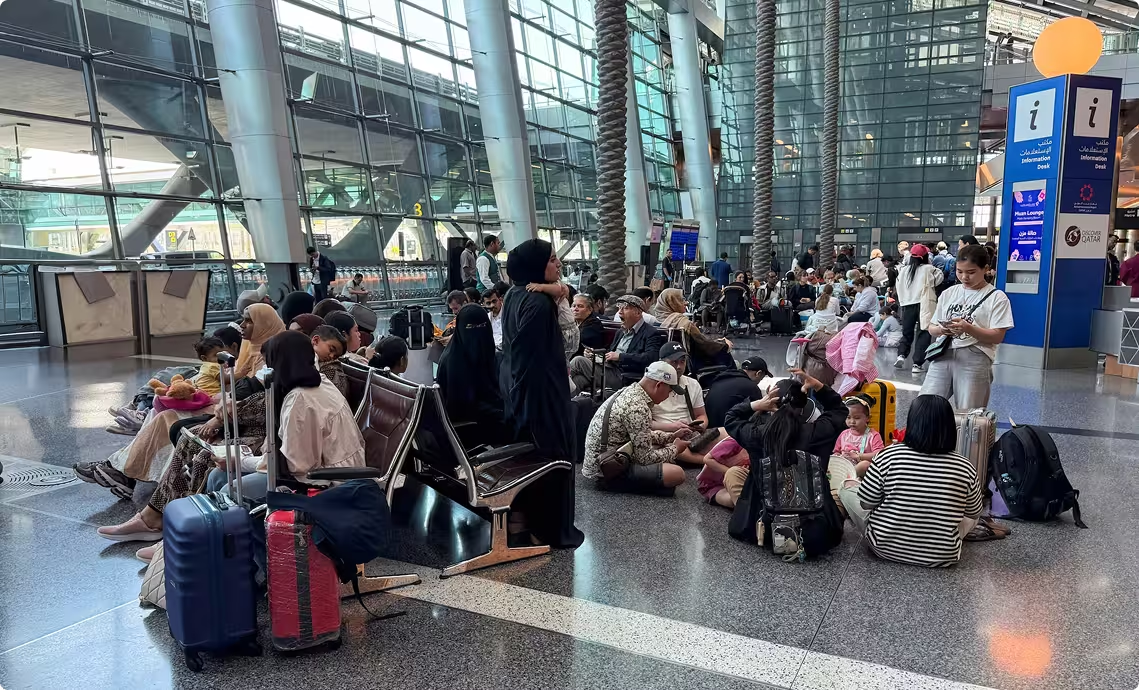
Airlines canceling flights in the region now reads like a roll call of global carriers. British Airways has extended suspensions to Tel Aviv, Dubai, Doha, Amman, Abu Dhabi, and Bahrain through April and May. Lufthansa Group suspended Dubai, Abu Dhabi, Amman, Erbil, Beirut, Tel Aviv, and Tehran. KLM suspended Dubai, Riyadh, and Dammam through March 28. Cathay Pacific extended Dubai and Riyadh suspensions through April 30. Turkish Airlines is offering free rebooking across all Gulf and Middle East routes through March 31.
Cancelled Flights in Atlanta and the US Domestic Picture
The question for Americans traveling in the US is not just about flying to Iran or the Eastern Mediterranean. The Iran war's fuel shock is rippling into US domestic aviation in ways that are only beginning to show up in ticket prices. Atlanta's Hartsfield-Jackson logged over 350 cancellations during the March 16 storms and 170-plus by mid-morning on March 17, driven by storm recovery combined with TSA staffing shortages caused by the ongoing DHS partial government shutdown. If you have a connecting flight through Atlanta, Chicago O'Hare, or LaGuardia right now, most travel advisors agree: arrive at least three hours early, avoid basic economy tickets, and do not schedule connections shorter than three hours. The system is not absorbing disruptions at its usual rate.
Do Flight Prices Ever Go Down? What the Data Says for 2026
Yes, but the timing is more complicated than usual. Before the Iran strikes, KAYAK data showed international airfare down 10 percent year over year and domestic fares down 3 percent. The war changed that trajectory fast. Jet fuel climbed from $2.11 to $3.40 per gallon in ten weeks, a rise of over 60 percent. United Airlines was charging $846 for New York to London, up 177 percent from the prior week. The average US transcontinental ticket went from $167 to $414, according to Deutsche Bank analysis. Rob Handfield at North Carolina State University advises locking in prices now if you are traveling this summer. Buy a refundable or changeable economy ticket so you can rebook if fares drop later. Late August 2026 already looks 12 to 15 percent cheaper than peak summer weeks based on current booking data.
Book Smarter With Triwize
When fares swing daily and routes vanish weekly, where you book matters as much as when. Triwize compares airlines across price, routing quality, layover times, and carrier reliability - not just the cheapest available seat. Unlock exclusive discounts and deals, cancel with ease when plans shift, earn Triwize Coins on every booking redeemable against future trips, and get real human support whenever disruption forces a last-minute change.
Europe, Eastern Europe, and the Mediterranean
Tourism to Europe, Eastern Europe, and the Mediterranean remains people's top choices when it comes to travel. However, the pertinent Iran conflict and the looming war atmosphere can severely impact travel.
Best Time of Year to Visit Italy and Greece in 2026

Neither Italy nor Greece is affected by the Iran war operationally and both remain strong options for US and European travelers this year. The best time to visit Italy and Greece is late April through early June or September through October. These shoulder season windows offer better weather than winter, far smaller crowds than July and August, and fares that run 20 to 40 percent below peak summer prices. May is often the single best month for Rome, Florence, and Athens.
Eastern Europe and Eastern European Food Tourism

As per KAYAK's 2026 travel data, Eastern Europe is identified as the breakout travel region of the year. Sarajevo, Bratislava, Tallinn, and Krakow are all gaining significant search momentum. Eastern European food has also built real international interest, with searches for Eastern European food online rising steadily as food tourism drives itinerary planning. Warsaw, Budapest, and Bucharest all have direct or one-stop connections from major US and UK hubs at prices that remain significantly below Western European equivalents.
Spain, Portugal, and Safe Alternatives in 2026

There is no active military conflict affecting Spain or Portugal in 2026. Fares from Germany to Majorca, Lisbon, and the Canary Islands show some of the lowest price impacts from the Iran fuel shock of any European route. Croatia and Bulgaria are similarly affordable alternatives. Ukraine remains fully closed to tourism and commercial aviation since February 2022, with no realistic timeline for reopening. Travelers researching holidays in conflict-adjacent regions should check official government advisories rather than news headlines for destination-by-destination guidance.
The Eastern Mediterranean: What Is Open, What Is Not
Greece, Cyprus, and Croatia are open and operating normal commercial flight schedules. Turkey is open and Turkish Airlines is operating normally. Egypt is open and receiving flights. Israel is a different situation. Ben Gurion Airport began accepting limited repatriation flights in early March after a full closure at the start of the conflict. Most major carriers including British Airways have extended suspensions through late April and May. El Al has continued limited operations throughout and is the most reliable option for essential travel to Israel. Flying to Iran on any commercial carrier is not possible as of this writing. Iran's Imam Khomeini International Airport was fully closed in early March. Mehrabad International was attacked on March 7. Business travel to Iran is not feasible under current conditions, and the US State Department has issued instructions to Americans in the region to depart immediately. Tourism Iran, already restricted by sanctions before the war, is entirely off the table for the foreseeable future.
Direct Flights and Alternative Destinations Opening Up
One area of genuine good news: direct long-haul routes continue expanding on non-conflict corridors. Direct flights to Cape Verde now operate regularly from Lisbon, London Gatwick, Amsterdam, and Manchester, driven by strong demand for Atlantic island alternatives that sit entirely outside the conflict zone. Norwegian Airlines moved quickly when the Iran crisis hit, adding 120 extra departures from late March through mid-April to absorb displaced passengers from cancelled Gulf connections.
Jobs in Hospitality and Tourism: The Human Cost of War

The people most directly hurt by a sudden collapse in bookings are not airline shareholders. They are guides, drivers, hotel housekeeping staff, guesthouse owners, and restaurant workers who hold jobs in the hospitality and tourism industry without savings buffers or meaningful unemployment protection. The UNWTO estimates that for every dollar of airline revenue lost in a conflict-affected corridor, roughly two dollars of wider tourism and hospitality economic activity disappears with it.
Domestic US:Arrive three hours early at major hubs. TSA staffing shortages caused by the government shutdown have extended checkpoint wait times across Atlanta, Chicago, LaGuardia, and JFK.
Booking:Avoid basic economy fares. A refundable economy ticket lets you rebook without penalty if conditions change or fares drop.
Connections:Allow minimum three-hour layovers through any major hub. Missed connections currently mean 6 to 12 hour waits for the next available seat.
Insurance:Only cancel-for-any-reason (CFAR) coverage helps during a conflict-related disruption. Standard war exclusion clauses will leave most travelers without reimbursement.
Summer planning:Lock in tickets now but buy flexible. Late August runs 12 to 15 percent cheaper than June and July. Fly Tuesdays or Wednesdays for domestic routes to save 15 to 20 percent.
The Jordan case from 2023 is instructive. Petra, Wadi Rum, and Aqaba, none of which had any meaningful proximity to the Gaza conflict, saw booking collapses of 40 to 60 percent simply because they were in the Middle East. Local guides who had built careers over years of language training stopped getting work within weeks. Tourism and hospitality infrastructure does not come back automatically when bookings resume. It takes years.
The Longer View: What War Does to the Travel Industry Over Time
Global aviation news today is almost entirely about crisis management. But the industry has survived this kind of disruption before. The Russia-Ukraine war in 2022 erased the Siberian shortcut route model for European carriers almost overnight. The Red Sea disruptions of 2023 rerouted freight and aviation costs sharply higher. MH17 in 2014 permanently changed how airlines assess overflight risk. Each crisis reshapes the network in ways that do not fully reverse when the conflict ends.
Conclusion
The Iran-Israel war is the most severe of these events so far. The IEA has called the energy disruption post the Iran Conflict as the greatest global energy security challenge in recent history. Oil prices have crossed $114 per barrel. The Strait of Hormuz, which normally handles about 20 percent of the world's oil and LNG, has come to a near halt. The travel industry will survive this. What does not automatically survive is the local ecosystem of small operators, guides, and family-run properties that forms the texture of travel for most visitors. The industry has survived pandemics, oil shocks, 9/11, and a dozen regional conflicts in the last 25 years. It is not fragile. But the communities it serves often are.
The last step is, stay flexible and enjoy your vacation! To help you have the best European travel experience with ease and affordability, checkout Triwize , the best affordable flight booking website. You can book multi-country flights from here and plan a memorable trip with no hassle.
Sources: CNBC, NPR, CNN, Al Jazeera, Aviation Week, Time, The National, Euronews, Cirium, FlightAware, Argus US Jet Fuel Index, Squaremouth, OPSGROUP.
Frequently Asked Questions
Is the US going to war with Iran, and is it still ongoing?
The US-Israel war with Iran began February 28, 2026. As of late March, the conflict is ongoing with no ceasefire in place. Iran has launched retaliatory strikes on the UAE, Qatar, Jordan, Israel, and Cyprus. The US has not issued a formal congressional declaration of war.
Which airlines are canceling flights to Israel, Iran, and the Gulf?
Can I fly to Israel now?
Do flight prices ever go down after a war or conflict?
What is happening with cancelled flights at Atlanta airport today?
What is the best time of year to visit Italy and Greece?
Are there direct flights to Cape Verde from the US or Europe?
Does travel insurance cover war and conflict?
How does war affect jobs in the hospitality and tourism industry?
What is a connecting flight, and why does it matter more during a crisis?
Frequently Asked Questions
Is the US going to war with Iran, and is it still ongoing?
The US-Israel war with Iran began February 28, 2026. As of late March, the conflict is ongoing with no ceasefire in place. Iran has launched retaliatory strikes on the UAE, Qatar, Jordan, Israel, and Cyprus. The US has not issued a formal congressional declaration of war.
Which airlines are canceling flights to Israel, Iran, and the Gulf?
Can I fly to Israel now?
Do flight prices ever go down after a war or conflict?
What is happening with cancelled flights at Atlanta airport today?
What is the best time of year to visit Italy and Greece?
Are there direct flights to Cape Verde from the US or Europe?
Does travel insurance cover war and conflict?
How does war affect jobs in the hospitality and tourism industry?
What is a connecting flight, and why does it matter more during a crisis?